Why I'm Betting on Teda for Rapid Prototyping
November 28, 2025 • 0 minute read •
If you want to build a simple web app today, the industry standard advice is overwhelming.
You need a framework (React, Vue, Svelte). You need a build tool (Vite, Webpack). You need a package manager (npm, yarn, pnpm). You need to configure Tailwind. You need to choose a state management library.
By the time you've set up your "Hello World," you've spent an hour configuring tools instead of building your idea.
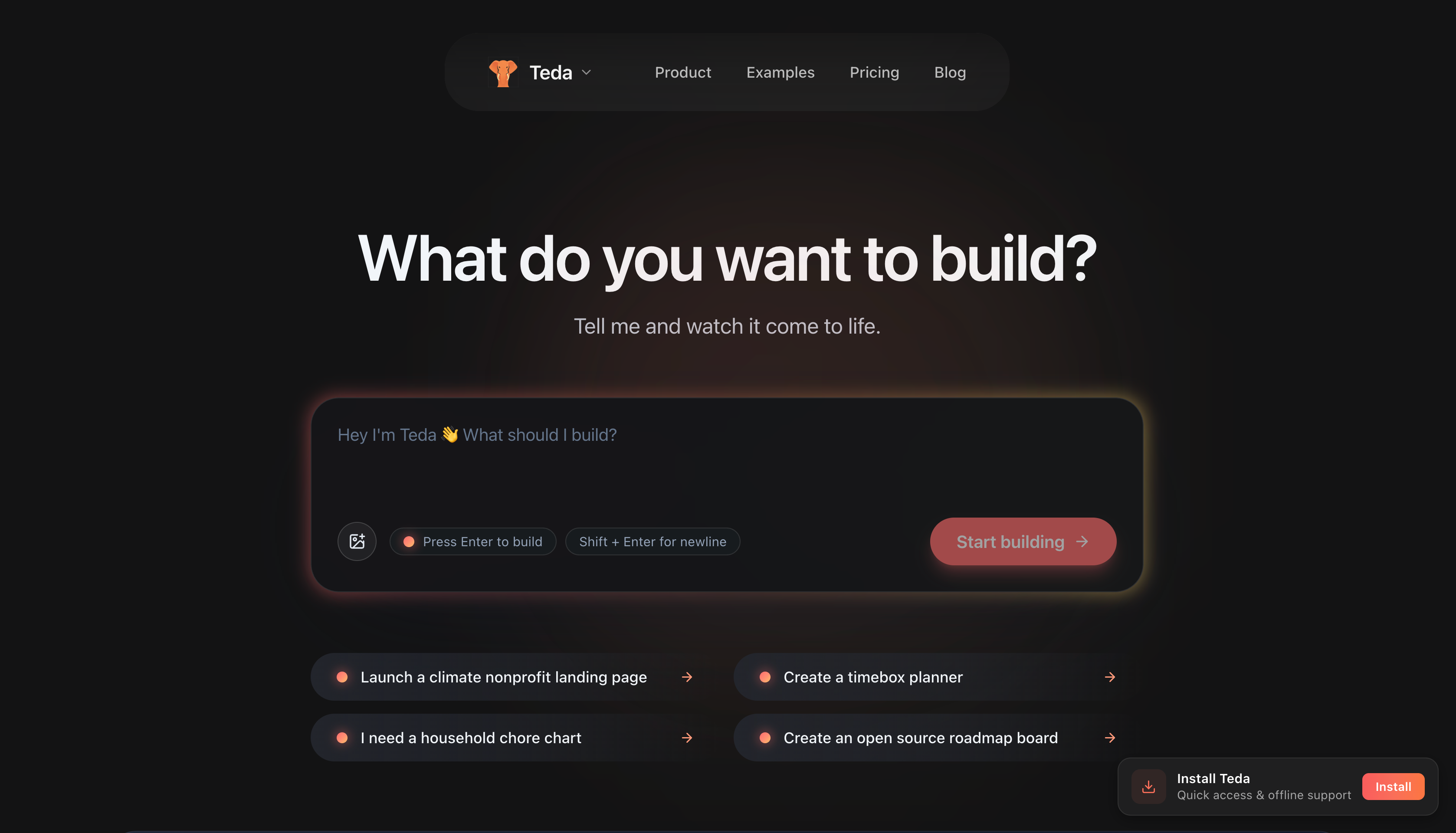
I built Teda.dev to solve this exact problem: the gap between having an idea and seeing it work in a browser should be minutes, not hours or days.
The "Buildless" Philosophy
Teda is built on a controversial but refreshing premise: Modern web development is too complex for prototyping.
I've become so accustomed to my complex toolchains that I've forgotten the power of the fundamentals. Teda generates apps using what they call "Boring Tech":
- HTML5 for structure
- Tailwind CSS (via CDN) for styling
- Vanilla JavaScript (and jQuery) for logic
- localStorage for persistence
No npm. No build steps. No node_modules black hole.
Why "Boring" is Better
Why does this matter? Because it removes friction.
When I have an idea for a internal tool or a quick proof-of-concept, I don't want to debug Webpack configurations. I want to see if the idea works.
With Teda, the workflow is radically different:
- Describe the app in plain English ("Build a habit tracker with dark mode and local storage").
- Watch it build in real-time (usually under 3 minutes).
- Iterate by chatting ("Add a streak counter", "Make the buttons blue").
- Deploy instantly or download the ZIP.
Because the output is standard, dependency-free code, it runs everywhere. It runs on your phone. It runs on a Chromebook. It runs offline. It will still run 10 years from now because it relies on web standards, not the flavor-of-the-month framework.
Why Not Lovable, v0, or Bolt?
If you've explored AI code generation tools, you've probably heard of Lovable, Vercel v0, and Bolt.new. These platforms promise similar rapid prototyping capabilities. So why choose Teda?
In my extensive testing and side-by-side comparisons (and I do this frequently while working on Teda), Teda consistently generates better UIs and more functional apps. The difference is noticeable:
- Better Design Quality: Teda's output has superior spacing, color harmony, and visual hierarchy. The apps look production-ready, not like prototypes.
- Cleaner Code: Because Teda uses vanilla JavaScript and simple HTML/CSS, the generated code is readable and maintainable. No framework bloat, no confusing abstractions.
- Actually Works: I've found that Teda-generated apps have fewer bugs and edge cases. Features work as described more consistently.
- True Ownership: With Teda, you get static files you can host anywhere forever. No vendor lock-in, no surprise pricing changes, no platform dependencies.
Platforms like Lovable and Bolt force you into complex frameworks and backend dependencies for even simple apps. They're trying to be everything to everyone, which means they're not optimized for the simple, focused tools most of us actually need.
Try it yourself: Take the same prompt and run it through Teda, Lovable, v0, and Bolt. Compare the UIs, the code quality, and how well the features actually work. I think you'll see what I mean.
Focused on the "Single-Player" Experience
Teda isn't trying to build the next Facebook or Salesforce. It explicitly avoids backend complexity.
It focuses on "single-player" apps: tools that live in your browser and store data on your device. Think habit trackers, budget planners, pomodoro timers, or design tools.
For 90% of the ideas I have, I don't need a scalable backend database. I need a working interface. Teda nails this use case better than anything else I've seen.
Conclusion
I'm not throwing away my production stacks. For complex, multi-user SaaS products, I still need my frameworks and backends.
But for validating ideas? For building internal utilities? For quickly visualizing a concept?
I'm betting on Teda. Because sometimes, the fastest way to build the future is to use the boring tech that already works.